Ollama
@dsh-ai-providers/ollama is the native Ollama provider maintained by Firefox2100 as part of this project. It speaks Ollama's own API rather than its OpenAI-compatible layer, because the native API exposes request controls the compatible one leaves out. It is not an official DSH or Ollama package.
Supported capabilities
| Capability | Native endpoint |
|---|---|
| Language models | POST /api/chat (newline-delimited JSON stream) |
| Model discovery | GET /api/tags, then POST /api/show for each model |
| Model control | GET /api/ps for status; POST /api/generate without a prompt to load, and with keep_alive: 0 to unload |
| Embeddings | POST /api/embed |
Ollama has no reranking, TTS, STT, or image-generation API in this plugin's scope, so those services are not registered.
Configure a connection
Open Settings > Providers > Ollama connections. The default connection is a local server:
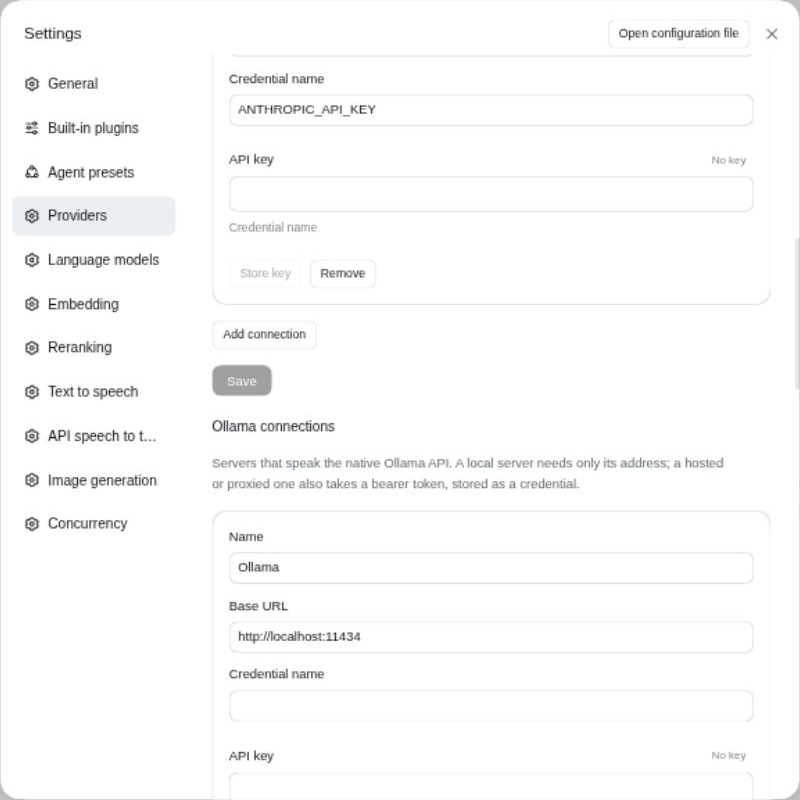
| Setting | Default |
|---|---|
| Base URL | http://localhost:11434 (with or without a trailing /api) |
| Credential reference | empty: a local server needs no key |
| Stream silence limit | 5 minutes |
| Embedding request timeout | 2 minutes |
For a hosted or proxied server, enter a credential name and store the token; it is sent as Authorization: Bearer. The secret is stored through DSH's credential service, never in the profile.
Configure routes and models
Create a route, select a connection, and add models by their exact Ollama names (for example qwen3:8b). List models on the server asks /api/tags and /api/show and adds a model with what the server reports it can do: image input, thinking, and its context window. Models that only embed are left out of the list.
Thinking models get reasoning levels from discovery: Off and On (think: false and think: true) for most, and Low, Medium and High for gpt-oss, which takes a level and cannot turn thinking off.
:::warning Set numCtx
A model's context window is what it supports. The context Ollama allocates for a request is num_ctx, and when a request does not set it the server uses its own default, which is often 4096 tokens or less. A longer prompt is then cut silently from the start. DSH uses the model's contextWindow to decide when to compact a conversation, so the two must agree: set numCtx on the route or model to the context you want to pay for in memory. The provider never raises it for you, because the model's maximum can need far more memory than the machine has.
:::
Controls
Route, model and policy sampling use the common fields every provider has, plus Ollama's own, in the same object. Absent means the server's default.
| Field | Request field | Notes |
|---|---|---|
temperature, topP, topK, minP, seed, stop | options.* | Common fields |
frequencyPenalty, presencePenalty | options.frequency_penalty, options.presence_penalty | Common fields |
repetitionPenalty | options.repeat_penalty | Common field |
maxTokens | options.num_predict | Common field; the model's output limit applies when nothing sets one |
numCtx | options.num_ctx | See the warning above |
repeatLastN, typicalP, penalizeNewline | options.repeat_last_n, typical_p, penalize_newline | |
mirostat, mirostatTau, mirostatEta | options.mirostat* | |
numKeep, numBatch, numGpu, mainGpu, numThread, useMmap | options.* | Runtime tuning |
keepAlive | keep_alive | 5m, 1h, -1 for ever, 0 to unload at once |
think | think | true, false, or low, medium, high |
format | format | json, or a JSON schema the answer must follow |
body | top level | Anything else the server accepts |
The reasoning level a chat selects, then body, win over the typed fields. toolChoice: none withholds the tools. Ollama has no way to require a tool call, so required and a named tool cannot be enforced and the model decides.
Native request mapping
The provider supports system prompts, text and image content (images are sent as base64 and need a model marked for vision), tool declarations and tool results, streamed text, thinking, and tool calls, and token usage. Ollama returns a tool call whole and without an id, so the provider gives each call an id of its own. A tool result is matched to its tool by name. Files remain tool-readable text handles, and offloaded images remain placeholders.
Embeddings
Select Ollama in the Embedding tab, choose a connection and a model (default nomic-embed-text). Texts are sent in batches of batchSize. Settings:
- Vector dimensions: for models that can shorten theirs. Also a request option chosen before a session's first request.
- Context (
num_ctx) and texts longer than the context: cut to fit (the default) or refuse. - Keep loaded: how long the model stays in memory after a request.
Ollama has no query/document distinction, so inputType is ignored.
Errors and cancellation
HTTP and stream failures are mapped to DSH language-model failure classes: authentication, rate limiting, usage limits, invalid requests (including a model that is not pulled), context overflow, server failures, timeout, and cancellation. An error the server reports inside a stream is classified the same way.